
FIRST Robotics Competition
FIRST is the reason I went to college. It set me on the path to becoming a teacher and an engineer, and to the university where I met my wife. I can trace the life I have today back to two high school teachers encouraging me to join the robotics team they were forming.
At Lower Merion, Mr. Piotrowski and Mr. Kressly helped me find that path. I was the theater kid who didn't think he needed college. An invitation to help build a wooden crate became a place on FRC Team 1712, Dawgma, in its founding season in 2006. I found people who trusted me to build things, take responsibility, and contribute. That changed what I wanted for myself.
I returned as a mentor, eventually studied Technology and Engineering Education at Millersville, and became a teacher myself. I also met my wife there. My career and my family both grew out of a path that started with that team. When I talk about the value of FIRST, I understand it firsthand.
That's why FIRST will always be special to me. Two teachers opened a door that changed my life. I keep coming back as a mentor, judge, and event manager because I want other students to have that opportunity too.
Today my focus is delivering competitions for FIRST Chesapeake — coordinating the referees, judges, inspectors, field crews, and volunteer staffs that make a three-day event with hundreds of students run on schedule. For the 2027 season I will serve as Event Manager of the Central Maryland District Event at South River High School and as Event Manager of the FIRST Chesapeake District Championship at Showplace Arena — the region's culminating event.
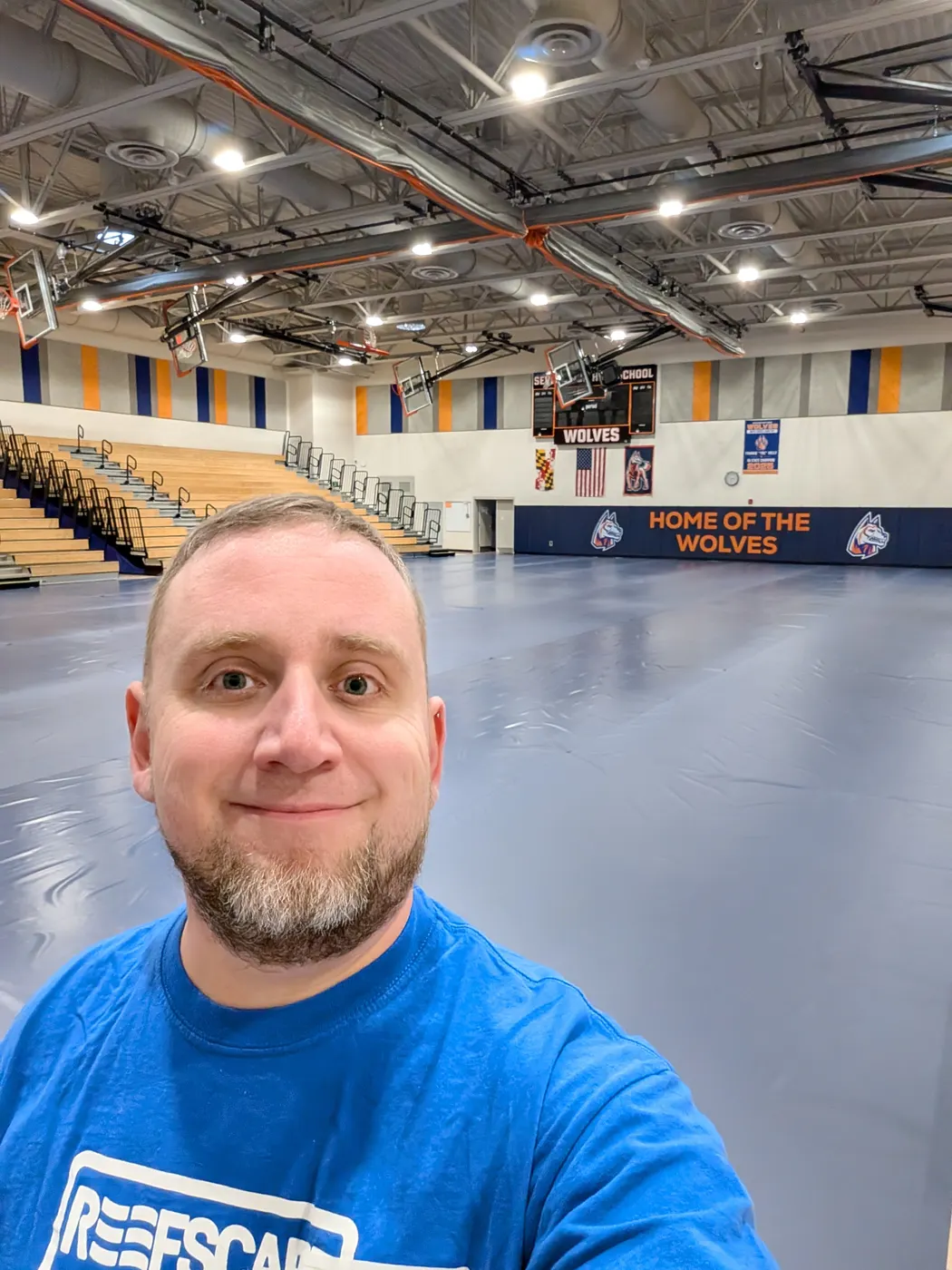
Hours before doors open at the 2026 Severn District Event.
Timeline
- 2006 Founding student, FRC Team 1712 Dawgma — the start of my path to college and teaching
- 2007–present Mentor for multiple FIRST teams
- 2013–2017 Lead Mentor & Teacher Advisor, Team 1111 Power Hawks
- 2013–present FRC and FTC Judge — district events through the FIRST World Championship
- 2015 Planning Committee, FIRST Chesapeake Regional Event; built the relationship with Former Delegate Kirill Reznik that led to Maryland robotics funding
- District transition FIRST Chesapeake District Planning Committee — participated in the change from the regional model to the district model
- 2015–2016 Secured $250,000 in annual Maryland robotics funding through work with Former Delegate Kirill Reznik and student advocacy
- 2016 Hosted and event-managed a FIRST Chesapeake district event
- 2017 Team 1111's first event win
- 2016–2026 Event Manager for four FIRST Chesapeake district events; Assistant Event Manager, District Championship (2018)
- 2027 Event Manager, Central Maryland District Event; Event Manager, FIRST Chesapeake District Championship (upcoming season)
Engineering and systems leadership
A district competition is a system of systems: ~36 teams, 700–1,500 students, 100+ volunteers, and three days of matches that have to stay on schedule. As Event Manager I coordinate the specialized volunteer groups — refereeing, judging, inspection, field operations, pit administration — and make sure their work integrates into one reliable operation.
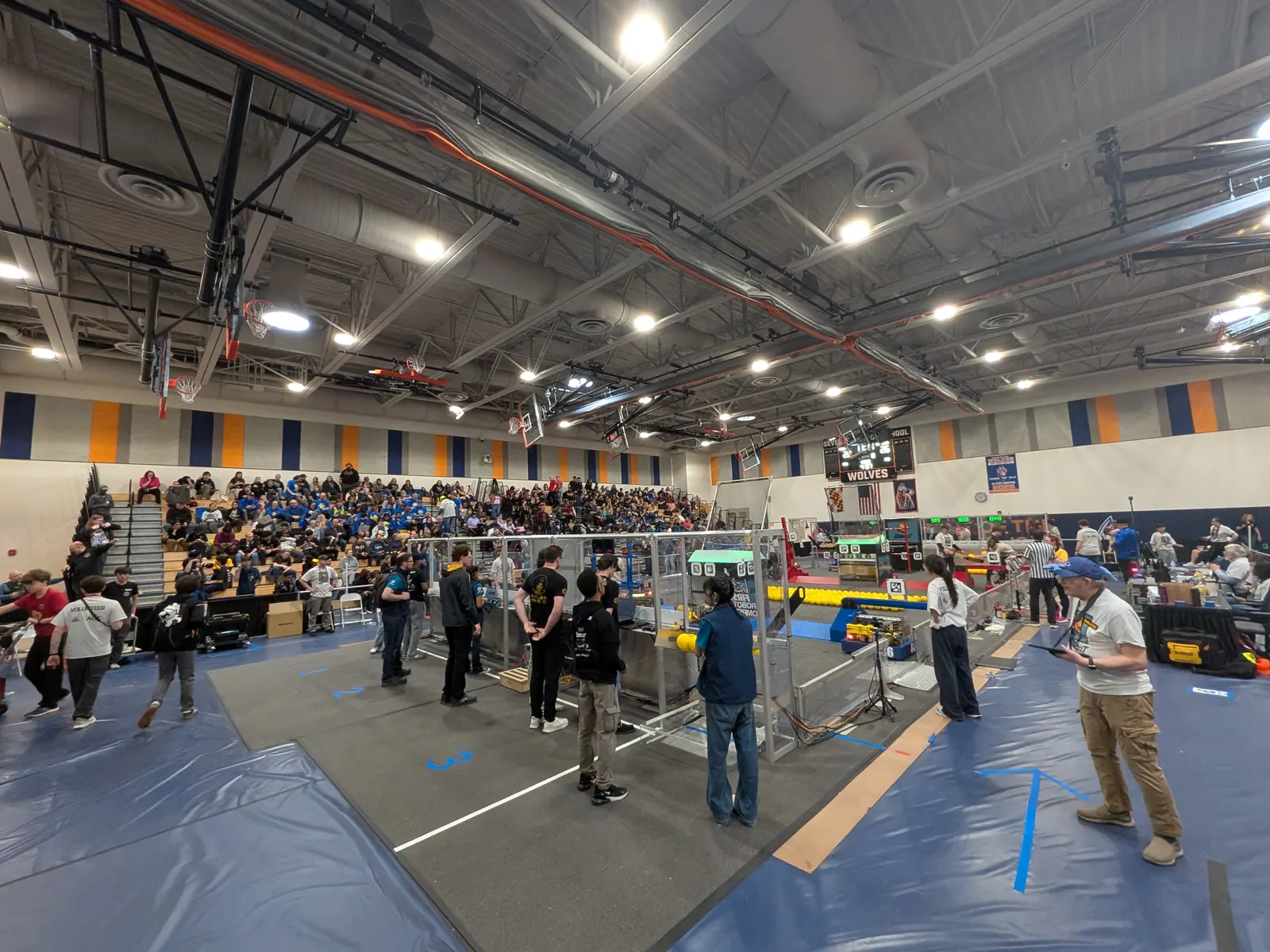
The same gym during playoffs — the 2026 Severn District Event in full swing.
That is the same job systems engineering does on a hardware program: define the interfaces, trust the specialists, watch the critical path, and manage escalations before small failures ripple outward. Event leadership taught me that discipline years before I applied it to autonomous platforms.
Teaching and mentorship
As Lead Mentor of the Power Hawks (2013–2017), I focused on building an engineering organization rather than coaching a robot build. The program grew from roughly 36 FRC students to more than 60, added three FTC teams, and ran with a staff of 30+ professional mentors each season. Students worked in functional subteams with real ownership; my job was structure, leadership development, and keeping the program aligned with its mission.
The outcomes are the point: more than 500 students came through the program in that period, roughly 80% pursued STEM degrees, and 98% went on to four-year universities. Competitively, those seasons brought the team's first event win (2017), two finalist appearances, three World Championship qualifications, and Chairman's and Engineering Inspiration awards at both regional and district levels.
As a judge — primarily a Team Attributes Judge from district events up through the World Championship — I evaluate the same things I tried to build as a mentor: student ownership, engineering culture, and the structures that let teams sustain themselves beyond one graduating class.
Programs and advocacy
I secured $250,000 a year in Maryland funding for after-school robotics through my work with Former Delegate Kirill Reznik. That effort began with a relationship I built with him at the 2015 FIRST Chesapeake Regional Event, where I served on the planning committee.
During the 2015–2016 season, I turned that relationship into a legislative effort with the Power Hawks. As the primary point of contact, I worked directly with Reznik and coordinated students' advocacy for the legislation, which passed. For me, expanding access to robotics was personal: I knew what one invitation to join a team had done for my own life.
I also served on the FIRST Chesapeake District Planning Committee, participating in the transition from the regional model to the district model. Each year I led students to Capitol Hill to advocate for STEM education directly with members of Congress.
In 2016 the team hosted a FIRST Chesapeake district event at our school — and deliberately sat out the competition so students and mentors could staff and run it, seeing the operational side of the program firsthand.
What FIRST taught me
- Engineering is a team sport. The best teams operate like small engineering organizations — success is integration across specialties, not a lone expert.
- Leadership means enabling others. Whether coordinating mentors or 100+ event volunteers, the job is building the environment where experts do their best work.
- Systems thinking matters. Small failures ripple; stable systems come from understanding how components interact.
- Culture drives outcomes. Teams with ownership and curiosity out-build teams with better parts.
These lessons carried directly into how I design hardware platforms like SENTRY, how I teach engineering, and how I run integration on professional autonomous systems.
Full history
The complete chronological record — event operations detail, judging roles, the Power Hawks program structure, and the advocacy work — lives on its own page: